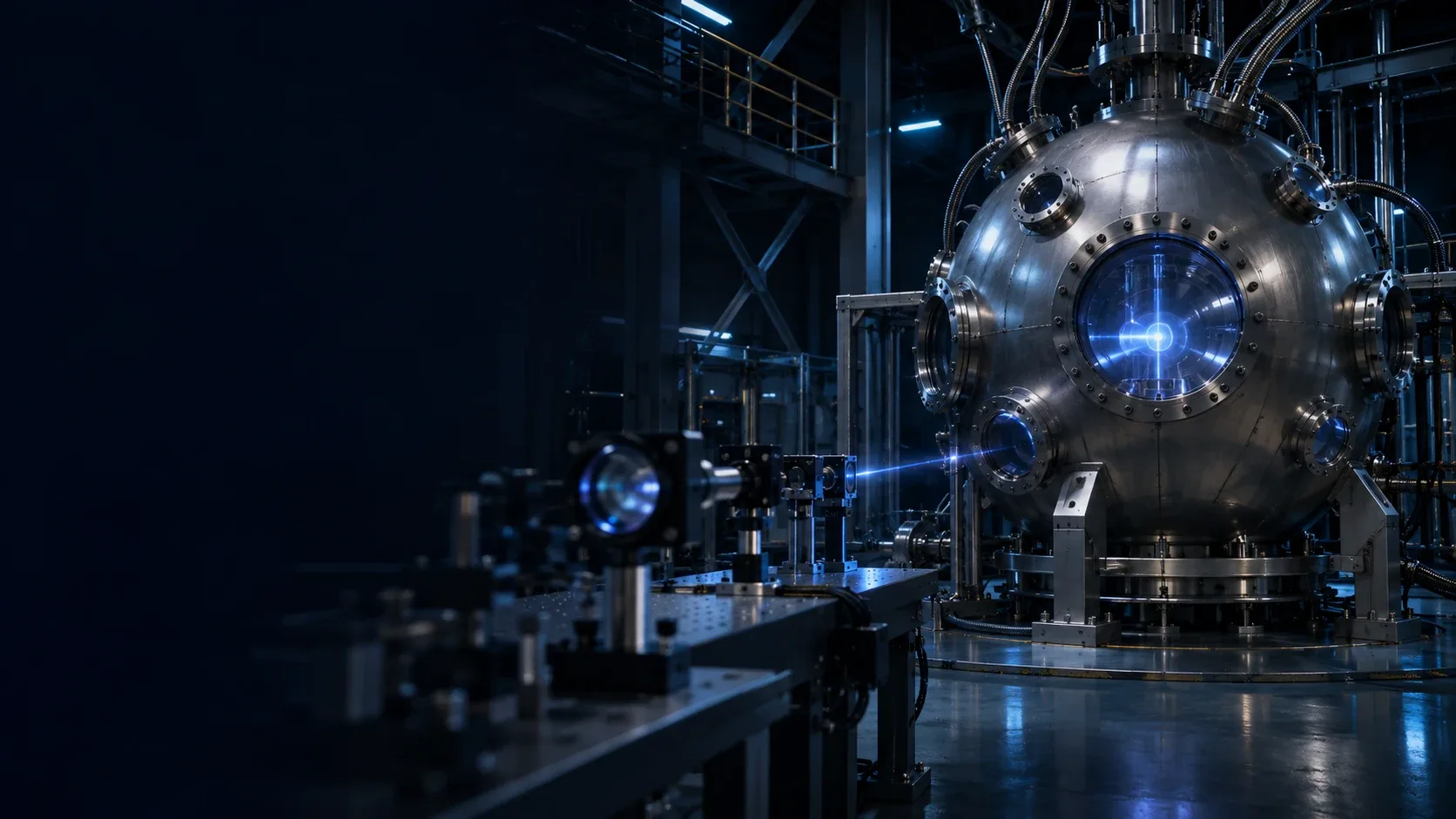
PLX · Los Alamos
PLX: forming a spherical liner from merging plasma jets.
The Plasma Liner Experiment is a Los Alamos National Laboratory facility for research on plasma-jet-driven magneto-inertial fusion. It was the first to form a fully spherical plasma liner from many separate supersonic jets.
Researchers measured the liner’s uniformity and shape, and the plasma density and temperature at different stages of the implosion. Earlier PLX work studied the merging of jet pairs and of liner sections.
What these data can test
- Jet merging and the shocks between jets, the main risk to implosion symmetry.
- Requirements for timing and matching of the plasma guns.
- Calibration of the liner model before GPU ensemble runs.
NIF · Livermore
NIF: ignition-scale D–T yield in a single shot.
In December 2022 the National Ignition Facility achieved ignition for the first time: fusion energy exceeded the laser energy delivered to the target. Ignition has been repeated many times since, and in 2025 the yield exceeded the energy on target more than fourfold.
An important caveat: this gain is measured against the energy on the target. The laser itself draws far more energy from the grid per shot, and shots are hours apart. A pulsed engine with frequent bursts is still a long way off.
What these data can test
- A realistic D–T yield per pulse.
- The share of energy in fast neutrons and the resulting shielding needs.
- The gap between a single shot and frequent pulses, the main open question.